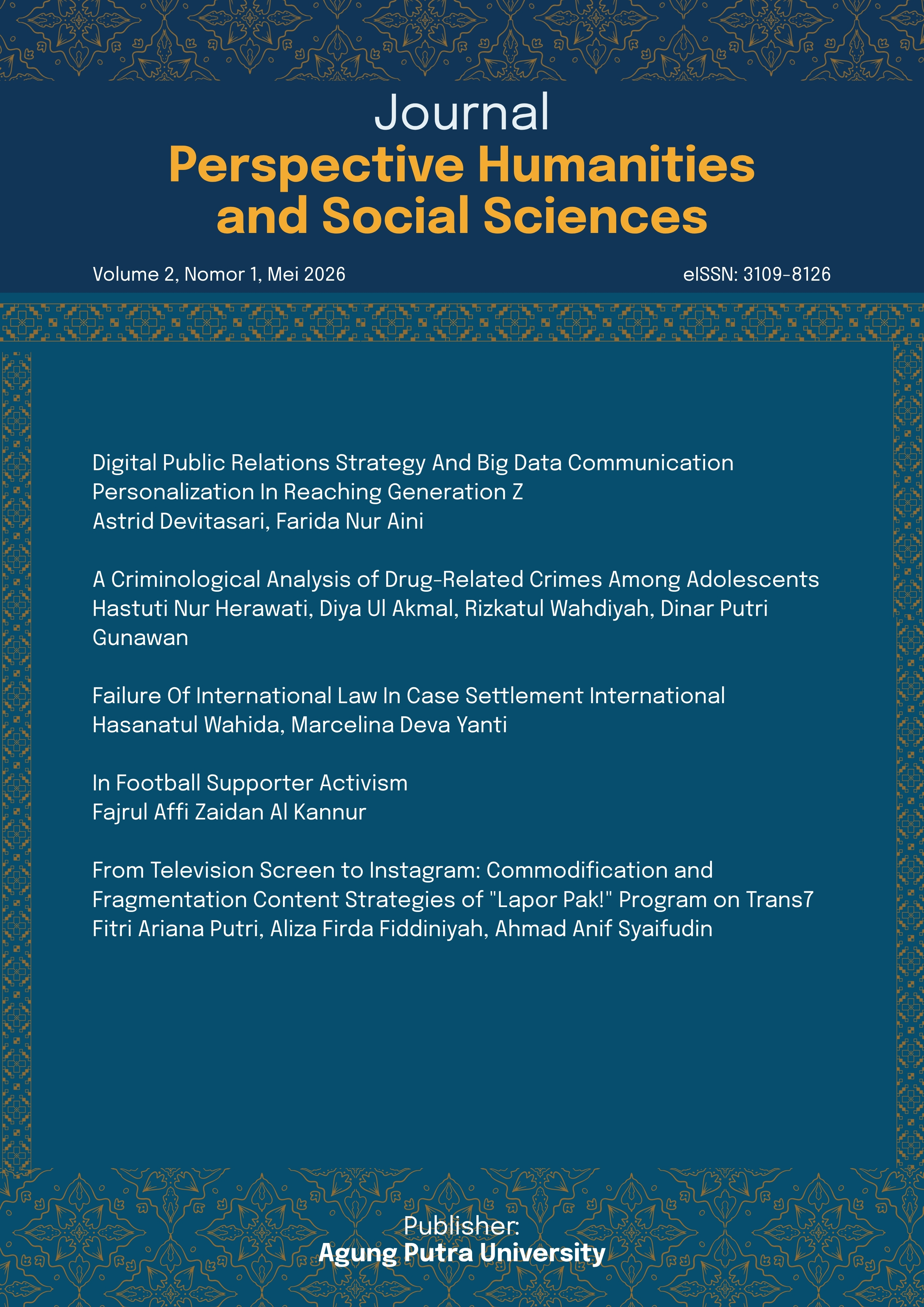
In Football Supporter Activism
Keywords:
football modernization, fan activism, against modern football, counter- hegemony, counter-discourseAbstract
In the contemporary era, football has become increasingly intertwined with commercial interests due to the modernization of the sport. Football supporters represent one of the primary stakeholders who perceive their interests as being marginalized by this modernization. This condition has driven the emergence of resistance manifested through the “Against Modern Football” movement. This study aims to understand the counter- hegemony efforts initiated by the Bandung Supporter Alliance through discourse. The findings of this study indicate that the activism carried out by the Bandung Supporter Alliance constitutes a form of counter-hegemony closely linked to the construction of counter-discourses disseminated via social media. The organization of discourse is capable of forming a new common sense, which serves as a central nodal point in the counter- hegemonic process. This discursive organization involves two key components: the war of position, and normative and spontaneous grammar. The war of position pertains to discursive critique aimed at destabilizing the discourse of football modernization while promoting counter-discourses. Meanwhile, normative and spontaneous grammar relates to grammatical truth and appropriate communication modalities. This involves political language choices that align with the strategic interests of the Bandung Supporter Alliance. The findings of this research highlight the critical role of communication and discourse in counter-hegemonic endeavors within football fan activism.
References
Afrianto, J. (2022, June 10). Against Modern Football. Retrieved from Kompasiana.com: https://www.kompasiana.com/jemmyafrianto8967/62a23f632098ab6b37066262/ against-modern-football?page=all#section1
Association, F. (1991). Blueprint for the Future of Football. London: The Football Association.
Braun, V. (2006). Using thematic analysis in psychology. Qualitative Research inPsychology, 77-101.
Brough, M., & Shrestova, S. (2012). Fandom meets activism: Rethinking civic andpolitical participation. Transformative Works and Cultures, 10, 1-27.
Burnham, P., Lutz, K. G., & Grant, W. Z. (2008). Research Methods in Politics.
Basingstoke: Palgrave Macmillan.
Corning, A. F., & Myers, D. J. (2002). Individual Orientation Toward Engagement in Social Action. Political Psychology, 23(4), 703-729.
Creswell, J. W. (1998). Qualitative Inquiry and Research Design: Choosing Among Five Tradition. London: Sage Publications.
Creswell, J. W. (2016). Research Design: Pendekatan Metode Kualitatif, Kauntitaif dan Campuran (4th ed.). Yogyakarta: Pustaka Belajar.
David, M., Kirton, A., & Millward, P. (2017). Castells, ‘Murdochization’,economic counterpower and livestreaming. Convergence: The International Journal ofResearch into New Media Technologies, 23(5), 497–511.
Denzin, N. K., & Lincoln, Y. S. (2018). The Sage Handbook of Qualitative Research (5th ed.). Sage Publication.
Dijk, T. A. (1993). Principles of Critical Discourse Analysis. Discourse and Society, 4(2), 249–283.
Donoghue, M. (2018). Beyond Hegemony: Elaborating on the Use of Gramscian Concepts in Critical Discourse Analysis for Political Studies. Political Studies, 66(2), 392–408.
Earl, J., & Kimport, K. (2009). Movement Societies and Digital Protest: Fan Activism and Other Nonpolitical Protest Online. Sociological Theory, 220-243.
Fitzpatrick, D., & Hoey, P. (2022). From fanzines to foodbanks: Football fan activism in the age of anti-politics. International Review for the Sociology of Sport, 57(8),1234–1252.
George, J. J., & Leidner, D. E. (2019). From clicktivism to hacktivism: Understanding digital activism. Information and Organization, 29(3), 1-62.
Giddens, A. (1984). The Constitution of Society: Outline of the Theory of Structuration. Polity Press.
Giddens, A. (1993). Sociology. Oxford: Polity Press.
Giles, D. C. (2013). The extended self strikes back: Morrissey fans’ reaction to public rejection by their idol. Popular Communication, 11(2), 116-129.
Gramsci, A. (2009). "Hegemony, intellectuals and the state", in Cultural Theory and Popular
(4th ed.). (H. John Storey, Ed.) Pearson Education.
Gramsci, A. (2013). Catatan - Catatan dari Penjara. Yogyakarta: Pustaka Pelajar. Gray, J., Harrington, C. L., & Sandvoss, C. (2007). Fandom: Identities And
Communities In A Mediated World. New York University Press. Hootsuite. (2022). Indonesian Digital Report 2022.
Ives, P. (2005). Language, Agency and Hegemony: A Gramscian Response to Post- Marxism.
Critical Review of International Social and Political Philosophy, 8(4),455–468.
Jenkins, H. (1992). Textual Poachers: Television Fans & Participatory Culture. Routledge. Jenkins, H. (2006). Fans, bloggers, and gamers: Exploring participatory culture. NewYork:
New York University Press.
Jenkins, H. (2012). Cultural Acupuncture’: Fan Activism and the Harry Potter Alliance.
Transformative Works and Cultures, 10.
Joyce, M. C. (2010). Digital Activism Decoded: The New Mechanics of Change. International Debate Education Association.
Joyce, M. C., & Beam, R. (2014). Activism Success: A Concept Explication. Angewandte Chemie International Edition, 6(11), 951-952.
Kaun, A., & Uldam, J. (2017). Digital Activism: Afer the Hype. New Media & Society,1-8. Kendall, G., & Wickham, G. (1999). Using Foucault's Methods. London: SagePublications. Kurniawan, F. E., & Margiansyah, D. (2019). AKTIVISME GERAKAN
KEAGAMAAN DALAM KONTEKS KEBUDAYAAN: Antara Penegakan
Syariat dan Anomali. Sosiologi Reflektif, 14(1), 41-57.
Laer, J. V., & Aiest, P. V. (2010). Internet and Social Movement Action Repertoires.
Information Comunication and Society, 1146-1171.
Laestadius, L. (2018). Instagram In: The SAGE Handbook of Social Media Research Methods. SAGE Publications.
Machin, D., & Mayr, A. (2012). How to Do Critical Discourse Analysis A Multimodal Introduction. SAGE Publication Ltd.
Marshall, C., & Rossman, G. B. (1995). Designing Qualitative Research (2nd ed.). London: Sage Publications.
Mattoni, A. (2012). Media practices and protest politics: How precarious workers mobilise. Ashgate.
Miles, M. B., Huberman, M., & Saldana, J. (2014). Qualitative Data Analysis: AMethods Sourcebook. London: Sage Publications.
Mills, S. (1997). Discourse. London: Routledge.
Mitu, B., & Vega, D. C. (2014). Digital Activism: A Contemporary Overview. Revistade Stiinte Politice, 103-112.
Neuman, W. L. (2013). Metodologi Penelitian Sosial Pendekatan Kualitatif danKuantitaif
(7 ed.). Jakarta: Indeks.
Patria, N., & Arief, A. (2015). Antonio Gramsci Negara dan Hegemoni (4th ed.) Yogyakarta: Pustaka Pelajar.
Patton, M. Q. (2015). Qualitative research & evaluation methods. California: Sage Publication.
Pawito. (2007). Penelitian Komunikasi Kualitatif. Yogyakarta: LKiS.
Downloads
Published
Issue
Section
License
Copyright (c) 2026 Fajrul Affi Zaidan Al Kannur

This work is licensed under a Creative Commons Attribution-NonCommercial 4.0 International License.